Confront War

“War itself is the enemy of the human race.” – Howard Zinn (historian, activist, 1922 – 2010)
"Will a positive global purpose overshadow the metaphor of war that is embedded in nationalism, tribalism, racial and ethnic divides? All of these divisions are man-made. They exist because we constructed them, and the secret is that whatever you made you can unmake."(Deepak Chopra, MD) . This page looks at why wars were fought, alternatives to war and how leaders manipulate people into believing war leads to peace.
How Wars Happen

When it comes to war, most of us fall victim to the distortions in the media, our learned belief that war is inevitable and just, and that there is no alternative. In the media we are hearing how Iran peace talks have failed giving the impression that peace is unattainable. Peace is attainable with the right leadership. Civilians do not create war. Our leaders do. According to the Modern War Institute, "we often find a familiar list of what leads us into war: bumbling leaders, ancient hatreds, intransigent ideologies, dire poverty, historic injustices, and a huge supply of weapons and impressionable young men and women." We add to that list profitability for a few, weak governance, and decisions limited to a rigged "on and off switch" with war the inevitable result. In this section we explore why wars happen and are there conflicts today where escalation into war may be averted?
From The The History Snob
The History Snob offers his personal insight into how "some wars felt fated—like history had locked the door and thrown away the key. Others stumbled into gunfire that cooler heads might’ve dodged. Pride, panic, politics—each played its part. But timing? The timing was everything. " A quick read.

Can We Get Ahead of Conflict Turning to War?
U.S. Central Command—also known as CENTCOM—oversees military operations in some of the hottest places on the planet. It commissioned Rand to identify a climate-related conflict that could lead to war. The researchers flagged one simmering conflict that has the potential to become the first real water war of the 21st century. Egypt and Sudan depend on the Nile but the river's major tributary starts in Ethiopia. And since 2011, Ethiopia has been building a hydroelectric dam across that tributary—a dam that Egypt has described as a threat to its very existence. Although both sides have threatened military action, several agreements have been signed to allocate water to upstream and downstream users - an agreement which establishes a maximalist approach to water allocation. As climate stress becomes more intense and more frequent a maximalist approach will need to be modified and agreed to by the three parties. and without an agreement, conflict can arise. The Egypt - Ethiopian - Sudan conflict can serve as an example of preventing war through mediating its causes.
Alternatives to War
WORLD BEYOND WAR
We know we want all wars to end. But what is the alternative? "People can't work for a world they cant imagine" Phil Gittins provides that image in his new 5th edition of A Global Security System: An Alternative to War.
This is World BEYOND WAR's blueprint for an alternative security system – one in which peace is pursued by peaceful means. AGSS relies on three broad strategies for humanity to end war: 1) demilitarizing security, 2) managing conflicts without violence, and 3) creating a culture of peace. Go to World Beyond War and find out more information on ending war.
Phill Gittins, PhD, is World BEYOND War's Education Director. He has 15+ years' programming, analysis, and leadership experience in the areas of peace, education, and youth. Phil is also a member of our Board, Fellowship for Global Nonviolence.
The Fifth Edition of A Global Security System: An Alternative to War (AGSS) is available on the World Beyond War website. Also, be sure to check out the complementary online study guide: Study War No More: A Concerned Citizens Study and Action Guide for “A Global Security System: An Alternative to War.”


Refocus the Military
The US expanded its number of military bases post WWII from a few to more than 3,000 bases worldwide. Its goal partly based on its global peacekeeper mission. Today, there are fewer bases and fewer troops devoted to peace. Some bases still deploy troops to serve with the UN peace keeping teams, to fight wildfires, disperse aid to those in disasters areas, to help rebuild communities, and in search and rescue operations. In our climate crisis, the "good" needs to prevail.
Support Security Not Military
Several countries operate without a traditional standing army, often relying on internal police forces, paramilitary units for security, or formal defense treaties with larger nations. These nations often cite economic savings, small population size, or a desire for peace as reasons to abolish their militaries. In 2026, the CIA World Factbook, 39 countries and territories do not have a military. Per the CIA’s definition, several of these states do not have a “regular military force,” but their national police forces act as de facto military forces, such as Costa Rica.
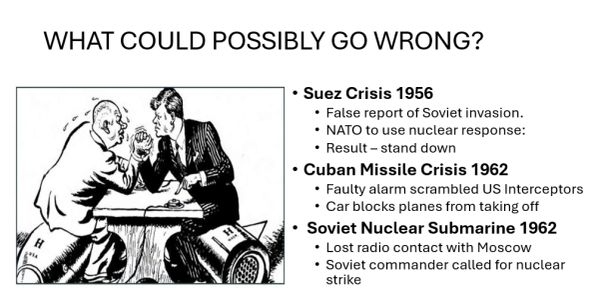
Lessons Not Learned - Yet
More Recent Concerns
- AI and Automation Risks: Simulations indicate that Artificial Intelligence models, if used for decision-making, frequently recommend nuclear strikes, increasing risks due to compressed decision timelines.
- Nuclear Modernization Challenges: The U.S. has faced long-term challenges maintaining an aging nuclear arsenal, with reports highlighting issues with warhead stability and reliability.
- February 28, 2026: The bombing in Iran killing more than 170 school children is believed to be a targeting error by US forces based on outdated intelligence and old maps.
Holding Officials Accountable
Your Voice To End War Matters
The world is experiencing wars at a frequency not seen in decades. The lethality and precision of weaponry has increased the number of civilian deaths including women and children, aid workers and peacekeeping forces. And vulnerable populations are facing genocide and mass atrocities including ethnic cleansing, war crimes, and crimes against humanity. The attacks on infrastructure providing water, fuel and power - necessities for survival, are under attack and based on the Geneva Convention amount to war crimes. DO YOU WANT THE WAR TO END? As of April 16th, the US Congress is divided on the war in Iran: a formal Authorization for Use of Military Force (AUMF) vs. withdrawal. This is a time to make your voices heard!
GET OUT AND VOTE
Voting holds politicians accountable at all levels of government. It provides each of us an opportunity to vote for an individual who aligns with our values, supports programs important to us such as diplomacy and conflict resolution over war. Remember that the War Institute (quoted in the introduction to this page) used the descriptive of "bumbling leaders" who are the ones who lead us into war. Bumbling leaders we voted for...