TAKE ACTION

Find Something & Then Do It
"LIFE IS SHORT. MAKE IT COUNT BY DOING GOOD. " Paul Harris, Founder, Rotary International
Turning information into nonviolent peace building is designed to make injustice and oppressive systems visible. We present nonviolent strategies you can use to connect, organize, & build a culture for peace. Also on this page are examples of "think globally, act locally" - what you can do in your community that can support a global movement. We also introduce you to networks, trainings and events offered by like-minded organizations.
Time Sensitive Announcement
.png/:/rs=w:1240,cg:true,m)
On-line Training
World Beyond War

War is not sustained by weapons, institutions, and policy alone. It is also sustained through culture: through the stories, images, symbols, language, music, memory, and performances that can make war seem normal, necessary, or heroic. These same cultural forms can also challenge militarism, strengthen movements for peace, and make alternatives to war visible. At its heart, this course brings forward the importance of understanding peacebuilding as both a science and an art.
A Living Laboratory Experience
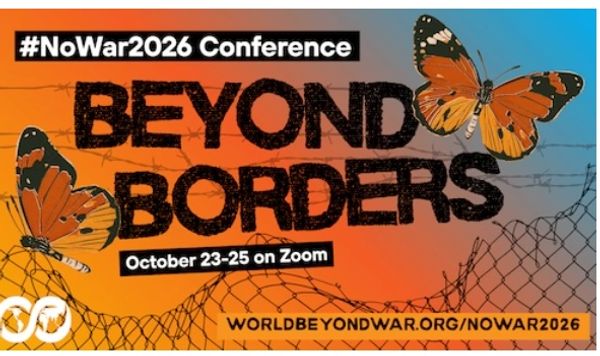
Throughout three days of panels, workshops, and breakout rooms, the #NoWar2026 Conference will examine the interconnections of the war system, migration, and the border industry, with case studies from around the world.
#NoWar2026 will create a space for global dialogue among activists, organizers, researchers, and educators to share lived experiences, learn from each other, and strategize for a world beyond the violence of both war and borders. Register today for this online conference. https://worldbeyondwar.org/nowar2026.
Engage

Nonviolent Protests Influence Change
One of the most effective ways to influence change is to engage with your community in nonviolent protests.

Arm Chair Engagement
One of the most effective ways to enable change is to write to your elected officials (local, state, federal, submit articles to your local newspaper, post on social media, submit testimony online and encourage your family, friends, and community to do the same.
Create A Schedule of Actions
Prepare a schedule of events, for you to engage in such as protest marches, elections (review voter pamphlets and evaluate proposed measures, candidates voting records, attend town halls, council meetings, and testify.
Join Data Center Protests
Opposing war and opposing data centers have common ground and that is the shutting down of data centers. You may not think of data centers as being essential to militarization - but they are. There are about 12,000 data centers globally with about 5,400 in the US, and about 3,000 owned by the US Department of Defense who will host commercial data centers on military bases in the future. By joining data center protestors you can amplify their voices and take advantage of their successes. Data centers are needed for generative AI which feeds into the critical infrastructure for militarization and warfare. The push for this era of digital-military-industrial fusion has become essential to the war system. Learn more at Data Center Watch
Is There A Defense Contractor In Your Town?
The defense industry supply chain is a massive, global network comprising over 200,000 suppliers, ranging from major prime contractors to specialized, small-tier manufacturers. L3Harris is a prime defense contractor ranking about 6th in the defense industry. More than a hundred activists from more than 20 statewide and local organizations gathered outside the L3Harris building in Northampton, MA in May of 2025 and again in January 2026. L3Harris manufactures components for weaponry including nuclear weapons. In a statement released by Demilitarize Western Massachusetts, the group decried the products the company makes, which supply almost every branch of the U.S. military. Photo credit: (Douglas Hook / The Republican)Douglas Hook
Create Community Resilience
Create Community
Develop Resilience
Develop Resilience

Community builds strength, stability, and creates resilience -- it always has and it always will. Community is family,, neighbors, associates at work, organizations - people coming together with a shared vision - to feel safe, to reduce violence, to promote peace, to "think globally, act locally." Community can be the simple act of sitting at the dinner table and talking about accomplishments, concerns of the day, and what plans you've created. Key attributes of community include trust, effective communications, active engagement, mutual support, a sense of belonging, inclusivity, diversity, and collective action.
Develop Resilience
Develop Resilience
Develop Resilience
"Community resilience is the ability to prepare for hazards, adapt to changing conditions, and withstand and recover from disruptions. Building resilience isn't just abut anticipating the next apocalypse - it's about preparing for loss of income, higher prices for groceries, another pandemic...BBC on their Connections series interviews the "preppers." Learn more from community resilience guidebooks: https://www.preventionweb.net/publication/documents-and-publications/guidebook-community-resilience; https://www.nist.gov/community-resilience/planning-guide
Be Prepared
Develop Resilience
Understand Your Risk
There are websites which provide instructions to build a "ready bag", an Evacuation Plan, a Communications Plan, actions to provide for family pets, livestock, and tools you will need to survive. In the US, FEMA.gov , trained teams provide workshops. We will add more resources throughout the year. Each country has its own processes for emergency response. Make sure you know what's available regionally and locally. For ready bags -
https://www.ready.gov/collection/emergency-supply-kit-checklist.
Understand Your Risk
Understand Your Risk
There are interactive maps in each region of the world to determine climate risk. https://www.germanwatch.org/en/cri, https://impactlab.org/map/#usmeas=absolute&usyear=1986-2005&gyear=1986-2005. There are interactive maps which combine both climate and conflict vulnerability: https://climate-conflict.org/www . In the US: https://resilience.climate.gov/, https://www.fema.gov/flood-maps/products-tools/national-risk-index.
Mitigate for Risks
As temperatures rise, tree canopy is proven to lower temperatures. If you live in an area with few to no trees, you can mitigate for high temperatures by planting trees to increase shaded areas and/or you can lobby your city officials to add trees to mitigate for what's known as an Urban Heat Island. Review mitigation guidelines with your community based on your risk level for flooding, wildfires, tornadoes, hurricanes...Over the next months we will add more mitigation resources.
Stay Connected
Developing a Communications Plan and securing tools to stay in communication during and after a cataclysmic event is essential to remaining resilient. There are many reasons where family members may separate; where you may need to know about road closures, a wildfire's movements, sudden changes in evacuation orders and to do that you will need a hand-crank radio, two-way phones. In an emergency cell towers and power may be shut off. Most states have emergency information.
Community Resilience In Conflict Areas
Gaza
Ukraine
Ukraine
Majed and his family were forced to flee south when their house was damaged by heavy bombardment. “I was terrified. I’d sleep every night next to my mother. It was very scary. We grabbed our bags and made a run for it.” Eight-year-old Majed is focused as he bakes bread in a makeshift tent in the south of the Gaza Strip.
Ukraine
Ukraine
Ukraine
Ukrainian designer Stanislav Drokin launched the Forget-me-not sculpture project. shaped from shell fragments from bombs and shaped into flowers. The pieces are symbols made to preserve the tragedies, destruction and grief that wars bring. Source: UN News
Kenya
Ukraine
Kenya
This young man escaped a civil war in Ethiopia only to end up in a refugee camp in Kenya where he has remained for the past 11 years and educated hundreds of children in make-shift schools. Here he is being interviewed for a Rotary Peace Fellowship, in his tent holding a flashlight in one hand and a phone in the other.
Syria
South Sudan
Kenya
Rania Kinge, founder of social enterprise I LOVE Syria and Damascus Concepts – is working with 130 displaced Syrian refugee women, helping them earn a living by creating handmade jewelry that are sold worldwide.
South Sudan
South Sudan
South Sudan
In 2023, rival warring groups, overnight, forced the displacement of thousands of families. In the picture above, neighbor-helping-neighbor is assisting a family seeking refuge to cross a lake. In South Sudanese communities, indigenous giving systems are lifelines. These informal networks are fast, flexible, and trusted. Unlike bureaucratic aid processes, they require no forms, no conditions, and no waiting. Source: Alliance Magazine
Yemen
South Sudan
South Sudan
Yemen faces multiple challenges, including conflict, displacement, and economic instability. Women-owned businesses in war-torn areas like Yemen, and Ukraine and Afghanistan act as vital community anchors, fostering resilience, and rebuilding social cohesion amid conflict. These entrepreneurs, often recovering from, violent conflict, create jobs, offer essential goods, and preserve cultural heritage, serving as catalysts for local peacebuilding and economic survival
Joy Of Networking
Join A Network
Our only way to surpass those who believe that peace can be achieved through violence is to act in coordination and solidarity.
A Webinar Aligning Climate Restoration & Peacebuilding
Kat Haber -- Climate Restoration Ambassador to Peace & Planet
“Real change happens when we stop running from the urgency and start sitting in the patience — that’s where the connections reveal themselves.” Kat Haber is a climate coach and the longtime organizer of TEDxVail. In 2014,she founded the WE Rotary Club of International Peace. The WE Rotary Club meets online via Zoom every other Monday. Members come from countries all over the world to encourage each other in our paths of peace, to learn about our world and cultures, and to work together on projects that promote peace. In our meetings we spend time getting to know each other and listening to speakers. If you would like to attend a meeting, contact Dotty Cline, dmrcline@gmail.com or Kat kathaber@aol.com

A Small Sample of Networks Online

https://africanpeacemaking.org/
https://africanpeacemaking.org/
https://africanpeacemaking.org/
.
https://worldbeyondwar.org/
https://africanpeacemaking.org/
https://africanpeacemaking.org/
https://www.fieldsofpeace.org/
https://africanpeacemaking.org/
https://www.fieldsofpeace.org/
https://www.cpeace.ngo/
https://africanpeacemaking.org/
https://www.fieldsofpeace.org/
https://www.peace-ed-campaign.org/
https://mutuallyassuredsurvival.world/
https://www.peace-ed-campaign.org/

https://www.peace-ed-campaign.org/
https://mutuallyassuredsurvival.world/
https://www.peace-ed-campaign.org/
https://mutuallyassuredsurvival.world/
https://mutuallyassuredsurvival.world/
https://mutuallyassuredsurvival.world/
https://peacepodcast.org/
https://mutuallyassuredsurvival.world/
https://mutuallyassuredsurvival.world/
https://www.climateandpeace.org/
https://www.internationalcitiesofpeace.org/
https://www.internationalcitiesofpeace.org/
https://www.internationalcitiesofpeace.org/
https://www.internationalcitiesofpeace.org/
https://www.internationalcitiesofpeace.org/
.
https://www.veteransforpeace.org/
https://www.internationalcitiesofpeace.org/
https://www.veteransforpeace.org/