Enable Peace

Peace Is Inevitable
"A JOURNEY OF A THOUSAND MILES BEGINS WITH A SINGLE STEP" - Lao Tzu
The world has a history of successful transformative peace movements. And we have had leaders who not only spoke passionately about peace but also opposed war, challenged nuclear proliferation, and supported increased foreign aid and domestic programs. We are not alone on our journey to peace - and we too can leave a legacy of a peaceful and healthy planet.
What's Your Vision For Peace?
Peace - What Is It?
What's your vision for peace? How will a peaceful world change your day-to-day life, the lives of your family, community and how you view our living planet? For a child who has only known war, "Maybe I won't have to hide under my bed when the bombs drop."

VISION FOR PEACE
In general, peoples' vision for peace extends beyond the absence of war, defining it as a proactive state anchored in justice, dignity, safety, and equality. It is envisioned as a world with active, non-violent conflict resolution, inclusive and diverse communities, a stable and democratic system of governance, and sustainable, responsible use of resources. And a leadership with cabinet-level positions dedicated to peace, an education system with curriculums on peace, and a refocused military to non-violent security with operations focused on our changing climate to rescue, to fight wildfires, to help mitigate disasters, and to protect our biodiversity.
THE UNITED NATIONS
The UN's vision is a comprehensive, forward-looking vision aiming to prevent conflict and foster global stability in a multipolar world. Grounded in the UN Charter, it prioritizes diplomacy, sustainable development, human rights, and the protection of civilians through updated peacekeeping operations, targeting emerging threats such as AI and climate change while reforming key institutions. For 2026, the UN’s vision for peace focuses on a "New Agenda for Peace" with key priorities: strengthening multilateralism, upholding the UN Charter, mitigating geopolitical divides, and investing in social cohesion, youth, and women to build resilient societies.
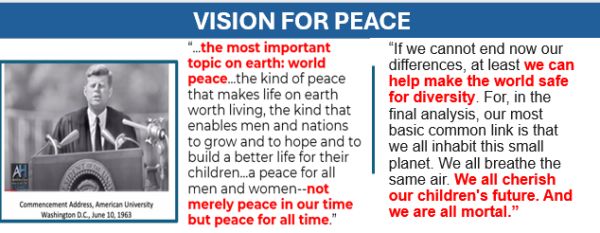
John F Kennedy
President John F. Kennedy established several key structural programs for peace, focused on fostering international development, reducing nuclear tensions, and improving foreign relations. Core programs included the Peace Corps (1961) for humanitarian service, the Alliance for Progress for Latin American economic development, the Food for Peace Program to distribute surplus food. U.S. Arms Control and Disarmament Agency (1961), Limited Test Ban Treaty (1963), Hotline Agreement (1963), USAID (1961)

Nelson Mandela
Nelson Mandela’s vision for peace was rooted in reconciliation, equality, and justice and nation-building to foster peace in post-apartheid South Africa. Key initiatives included the Truth and Reconciliation Commission (TRC), the Reconstruction and Development Programme (RDP) to reduce inequality, building a new 1996 constitution guaranteeing equality, and using sports, such as the 1995 Rugby World Cup, to unify racial groups.
Best Practices
Monks Walk For Peace
Monks Walk For Peace
Monks Walk For Peace

Buddhist monks walk for peace, from Texas to D.C. This a significant, rare event, often undertaken when the world feels out of balance. The 2,300 mile walk originated from the Hương Đạo Vipassana Bhavana Center in Fort Worth, Texas. It includes 19 monks from Thai, Vietnamese, Cambodian, and Nepali traditions to promote national healing, compassion, and unity. Together with their rescue dog
Aloka, “Walk for Peace”, was cheered on by crowds of thousands. As the monks took their places below the memorial, a song boomed from loudspeakers: “Spreading peace, love and harmony all the way to Washington DC.”
Peace Poles
Monks Walk For Peace
Monks Walk For Peace
The Peace Pole project was founded in 1955 in Japan by Masahisa Goi as a response to the destruction of World War II and the atomic bombings of Hiroshima and Nagasaki. Goi created the message "May Peace Prevail on Earth" as a universal prayer to promote global harmony. Today, more than 200,000 peace poles have been planted around the world with a global effort being led by Rotary International.
Peace Trails
Monks Walk For Peace
Peace Gardens
Peace trails are walking, biking, or hiking routes designed to promote, foster, or commemorate peace, often featuring designated stops for contemplation, local history, or symbolic landmarks like peace poles. These trails often combine nature with community reflection on nonviolence. Some include Sentiero della Pace (Italy): International Peace Garden Trails: Peace Olle Trail (Korea): front line of the WWI, of the Italo-Austrian war, and an emerging initiative, the Oregon Peace Trail.
Peace Gardens
Peace Gardens
There are two renowned peace gardens in the US: the International Peace Garden located on the border of North Dakota and Manitoba, established in 1932 to commemorate peace between Canada and the US and the International Peace Gardens in Salt Lake City, Utah. In Greece, Garden of Peace (Crete/Chania); Peace Garden Park (Somalia); Woodstock Peace Garden (South Africa); Garden of Heavenly Peace (Germany) and the many peace gardens located in cities & towns throughout the world.
Petition for Peace

"MAY WE HAND DOWN TO THE GENERATIONS WHO COME AFTER US, THE PROUD HERITAGE OF A WARLESS WORLD." Through the 1920s-30s, the Women’s Committee of the Welsh League of Nations Union (WLNU) led some ‘world-inspiring’ campaigns on Peace. The horrors of World War 1 having galvanized a generation against conflict, in 1923 women of Wales organized an unprecedented appeal. 390,296 women signed a Memorial petition, appealing to the women of America to join them in a call for ‘LAW NOT WAR’: for the United States to join and lead the new League of Nations.
Cities of Peace
International Cities of Peace is a formal Association of communities and you do not need to be an incorporated city to join. It can be dependent on history or proclamation, or by concerted community peacebuilding — by self-defining your large or small city, town, village, or neighborhood as an official City of Peace. By becoming a City of Peace, peace becomes more visible in your community. Take a look at their website and join.
Oregon PeaceFest
Oregon PeaceFest
Oregon PeaceFest

The Oregon PeaceFest is an annual community event hosted by the Rotary Club of Newberg, the Newberg Kiwanis, and George Fox University, featuring a carnival for children with non-profit groups each hosting a peace game for kids to play, live music, booths and a peace walk including a dedication for a new peace pole.
Hoops for Peace
Oregon PeaceFest
Oregon PeaceFest

In collaboration with the Oregon PeaceFest, George Fox University is championing its 1st Annual Hoops for Peace . Hoops for Peace is a community event tailored to a small town atmosphere but based on the successful outreach of the Spokane Hoopfest, the Elks Hoop Shot and other Hoops for Peace competitions.
The Role of Service Organizations
Rotary Peace Centers
Rotary International (RI) is one of several service organizations working towards peace. RI and its 46,000 clubs have invested heavily in peace programs: Rotary Action Group for Peace, International Peace Conferences, Peace Builder Clubs, Peace Pole Projects, positive peace projects throughout the world, peace parks at its annual convention, peace trails, and more coming. One of its main achievements are its 8 peace centers (the most recent Turkey). Full fellowships are offered to successful applicants each year. More information can be found at the RI website including fellowship applications.
Rotary & the United Nations
Dating back to 1945 when roughly 50 Rotary members served as consultants to the UN Charter Conference. Rotary International leaders were encouraged with the formation of the United Nations as a global organization for peace. Several books were issued to its worldwide clubs with the objective to facilitate discussion and support for the UN. Rotary International continues to have a strong relationship with the United Nations,. Today, Rotary holds the highest consultative status with the UN’s Economic and Social Council. They collaborate on promoting peace, education, and humanitarian efforts globally.